We are at a point where “AI anxiety” is no longer a distant possibility but a distress that is increasingly visible in corporations, institutions, and startups alike. Somewhere, hidden among the servers, there seems to be a “monster” that goes by the name of AI anxiety. While public discourse emphasizes how artificial intelligence will make our lives easier, in reality many of us feel a significant external pressure. It is that constant need to prove that we are “better than the algorithms we created to help us be better”.
The “indispensability” trap: when fear sets our pace
“I have to work harder so I become irreplaceable.” This is the mental trap that more and more professionals fall into as they try to manage their fear through exhausting effort. In this context, a dangerous self-defense mechanism appears: reactive over-productivity.
In an attempt to protect themselves, people tend to work overtime, answer emails at impossible hours, and take on side tasks. All of this is done in the hope that a huge volume of work will serve as a shield against automation or job restructuring. The message many of them repeat in moments of loneliness and fatigue is: “If I am exhausted, I still have a chance to keep my job!”
Why does fear of technology drive us toward exhaustion?
It is important to understand that burnout does not come only from the amount of work, but also from the lack of control and the uncertainty about the future. Here is how the perception of AI feeds this state of exhaustion:
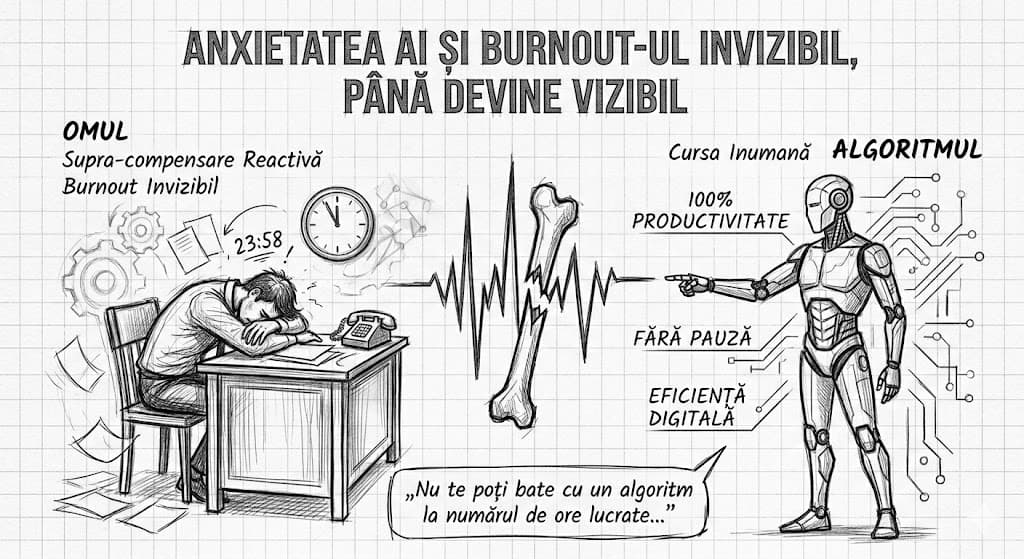
A race against a machine that never tires: it is impossible to win a productivity marathon against software that needs no sleep, coffee, or breaks. Trying to keep up this inhuman pace quickly leads to chronic exhaustion.
The devaluation of your own skills: when you see that a tool can generate in seconds what used to take you hours, a professional identity crisis can appear. This sense of looming “uselessness” is a central pillar of emotional burnout.
Performance under surveillance: there is constant pressure to deliver “human quality” (creativity, empathy, strategy) at a digital processing speed, which creates permanent cognitive tension.
“You cannot beat an algorithm at the number of hours worked; it has no feelings, but it also has no limits. Your only chance is to stay human, not to become a slower version of a computer.”
Reclaiming balance: how do we break the vicious cycle?
To avoid complete exhaustion, we need a gentle but firm change in our “survival” strategy:
Redefining your personal value: your value does not lie in the repetitive tasks that AI can take over, but in critical and ethical thinking and in managing human relationships. Once we understand this, we can look at the future with a clearer direction.
AI as an ally, not a rival: instead of working against technology to save your job, try to learn how to work with it to save your time.
Setting healthy boundaries: excessive work does not make you harder to replace; it makes you more prone to mistakes and to a medical collapse. A creative, well-rested employee will always be more valuable than an exhausted one. The basic principle remains: work smart, not hard!
The solution is not “more work” but a smarter and gentler approach toward your own limits. If we let fear dictate our pace, we risk being replaced not by a robot, but by our own inability to function properly.
Warning signs: listen to your body and mind
If you recognize yourself in more than three of the situations below, your inner engine may be running “in the red” for the wrong reasons:
Desperate overcompensation: you work overtime not out of real need, but to appear more involved than an algorithm.
Toxic comparison with the machine: you feel demotivated or “slow” when an AI tool offers a quick solution, forgetting that your value lies in context and judgment.
Panic-driven skilling-up: you obsessively try to learn new tools, not out of curiosity, but out of the paralyzing fear that your skills will expire tomorrow.
The pursuit of inhuman perfection: you stress excessively over tiny details, trying to be “irreproachable” through perfection.
Cynicism toward technology: viewing any automation as a personal enemy.
Professional isolation: avoiding collaboration out of fear that your expertise will be absorbed by the system and you will become dispensable.
A survival tip: if you feel you are in a race against the clock with a processor, remember that you are the one who holds the switch. Artificial intelligence is a productivity tool, not a standard of humanity.