
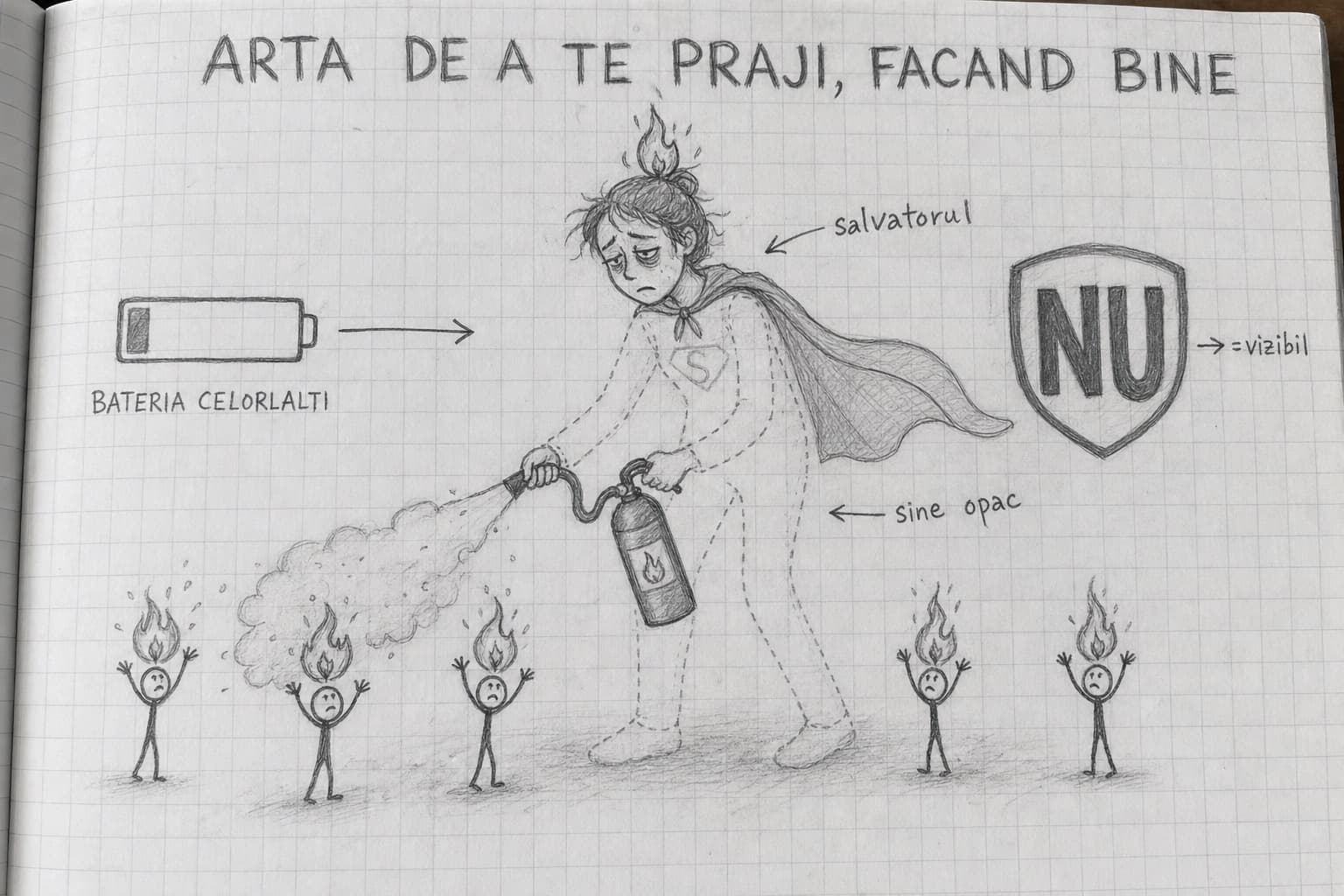
Among the people we interact with, we sometimes meet the kind of person who seems to permanently carry a fire extinguisher wherever they go. They use it to rescue those in distress, taking care of other people’s emotional fires. This is the “good person” who does not know how to say “no” and who finds meaning only when they are useful. Yet beneath this mask of nobility often hides a survival mechanism far more complex than a simple desire to do good.
Everyone else’s favorite battery
The rescuer works like an external battery: they seem to charge only at the moment they discharge toward others. This permanent orientation toward the outside is not just an act of kindness, but an unconscious strategy to disguise an inner world that feels foreign or shapeless to them — what we call an “opaque self”.
For the rescuer, silence is the greatest enemy.
In the absence of someone to help, they do not find a vibrant “I”, but an “identity fog” that triggers anxiety.
The question that haunts them in moments of isolation is simple and terrifying: “If I do not help you, who am I?”
The anatomy of burnout: the road to collapse
Unlike classic professional exhaustion, the rescuer’s burnout is an erosion of identity. They suffer from a “permanent empathic alert” and from a chronic inability to recognize their own limits. This process has clear stages that are often ignored:
Messianic enthusiasm: the feeling that “I can fix everyone”, accompanied by a hyperactivity that masks the need for rest.
Simmering frustration: irritation appears when others do not change despite all the effort, leading to resentment that the rescuer cannot own without “staining” their image as a good person.
Total apathy: the moment when “the mirror breaks”. If the rescuer is no longer reflected in someone else’s gratitude, they stop seeing themselves at all.
“No” – the word that makes you visible
Healing does not mean becoming “less good”, but having the courage to coexist with your own self, even when it feels confusing or empty. It is the vital transition from being necessary (a tool) to being present for your own person.
We must understand that a “No” said to someone else is not an act of cruelty, but a “Yes” said to your own health. Paradoxically, burnout is the body’s last form of protection: it is the way the body forces the rescuer to stop running from themselves and to become, at last, visible.
Conclusion
Burnout can appear in rescuers when that unspoken “no”, combined with the constant lack of appreciation from those they save, leads to the complete draining of the battery.